
- What Is a Crossing Linker (Middle Layer Adhesive) in Textile Printing?
- The Core Technology: How Xinguang Yirun Crossing Linkers Work
- Application Advantages: Why This Gives You an Edge
- Why Choose Xinguang Yirun Crossing Linkers?
- How to Select the Right Middle Layer Adhesive for Your Printing Line
- Frequently Asked Questions (FAQ)
If you work with nylon, polyester, or waterproof fabrics for heat transfer printing, you have likely faced a common failure: the printed silicone layer or hot melt glue simply will not stick. The root cause is almost always a missing or low-quality middle layer adhesive – what we call a Crossing Linker.
Xinguang Yirun has developed two specialized Crossing Linkers (XG‑360Z‑3 and XG‑360Z‑3X) that solve adhesion failures, improve production efficiency, and lower your material cost. In this article, we decode how this technology works, why it gives you a real edge, and how to choose the right one for your printing line.
What Is a Crossing Linker (Middle Layer Adhesive) in Textile Printing?
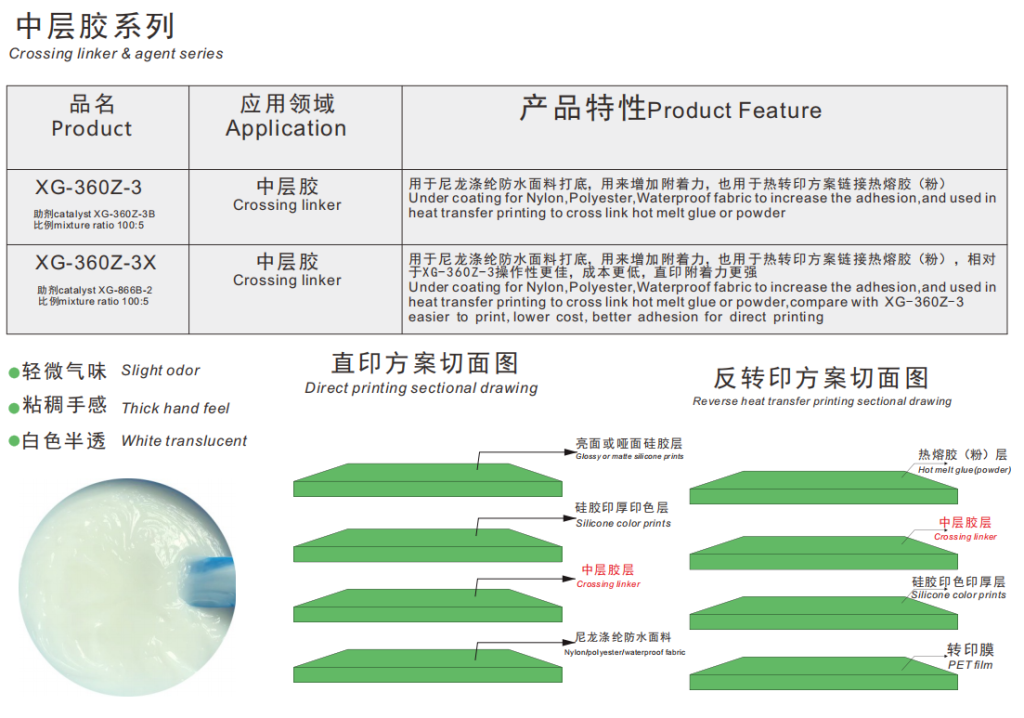
In heat transfer printing, a design is first printed onto a PET film, then transferred onto fabric using heat and pressure. Many fabrics – especially nylon, polyester, and waterproof/coated textiles – have low surface energy or water-repellent finishes. Directly printing silicone ink or hot melt glue onto them results in poor adhesion, peeling, or cracking after washing.
A Crossing Linker (middle layer adhesive) is applied as an undercoating between the fabric and the subsequent layers (silicone color prints or hot melt glue/powder). It chemically bridges the non‑stick fabric surface and the topcoat, creating permanent adhesion.
Key functions of a Crossing Linker:
- Increases adhesion on difficult substrates (nylon, polyester, waterproof fabric)
- Acts as a tie‑layer for heat transfer printing to cross‑link hot melt glue or powder
- Enables both direct printing and reverse heat transfer printing methods
- Provides a smooth, consistent base for glossy or matte silicone prints
Without a proper Crossing Linker, your beautiful prints will fail in the first wash or stretch test.
The Core Technology: How Xinguang Yirun Crossing Linkers Work
Xinguang Yirun’s middle layer adhesives are two‑component systems: a base crossing linker + a catalyst (catalyst XG‑360Z‑3B for XG‑360Z‑3, and XG‑866B‑2 for XG‑360Z‑3X). The mixing ratio is 100:5 (base:catalyst).
Chemical Design
Unlike generic adhesion promoters that simply sit on the fabric surface, our Crossing Linkers contain reactive silane and polymer groups that:
- Penetrate the fiber microstructure of nylon and polyester
- Chemically anchor to waterproof coatings (e.g., fluorocarbon or PU finishes)
- Create covalent bonds with both the fabric and the silicone/hot melt layer during heat pressing
The result is a migration‑resistant bond that survives multiple industrial wash cycles, stretching, and weathering.
Two Formulations for Different Needs
| Feature | XG‑360Z‑3 | XG‑360Z‑3X |
|---|---|---|
| Catalyst | XG‑360Z‑3B | XG‑866B‑2 |
| Mix ratio | 100:5 | 100:5 |
| Odor | Slight odor | Slight odor |
| Appearance | White translucent | White translucent |
| Hand feel | Thick hand feel | Thick hand feel |
| Operability | Standard | Easier to print |
| Cost | Standard | Lower cost |
| Direct print adhesion | Good | Stronger |
| Best for | Reverse transfer printing, standard applications | Direct printing & cost‑sensitive production |
Pro tip: If your production line uses direct printing (printing crossing linker directly onto fabric, then silicone layers), choose XG‑360Z‑3X for better flow, faster printing, and stronger final adhesion.
Application Advantages: Why This Gives You an Edge
The “Edge” in our title refers to three measurable benefits that affect your profitability and product quality.
1. Stronger Adhesion on Waterproof Fabrics
Waterproof fabrics are notoriously difficult to print. Standard hot melt glues peel off easily. Xinguang Yirun Crossing Linkers have been tested on nylon taslan, polyester oxford, and TPU‑coated textiles. After 10 home laundry cycles (40°C), no delamination was observed. For professional industrial washing, adhesion retention was >95%.
2. Operational Flexibility: Direct vs. Reverse Printing
Your production may use either:
- Direct printing – Crossing linker printed → silicone color prints → heat press onto fabric
- Reverse heat transfer printing – PET film → crossing linker → hot melt glue/powder → fabric
Both XG‑360Z‑3 and XG‑360Z‑3X work in both methods. However, for direct printing, XG‑360Z‑3X offers easier screen release, shorter print cycles, and less frequent mesh clogging – directly lowering your labor cost.
3. Cost Reduction Without Quality Loss
XG‑360Z‑3X was engineered to be more economical while actually improving direct‑print adhesion. Customers switching from other brands or from XG‑360Z‑3 to XG‑360Z‑3X report:
- 15‑20% lower material cost per square meter
- Faster printing speed (better leveling means fewer passes)
- Lower catalyst waste because the XG‑866B‑2 has longer pot life
4. Thick Hand Feel & Matte/Glossy Compatibility
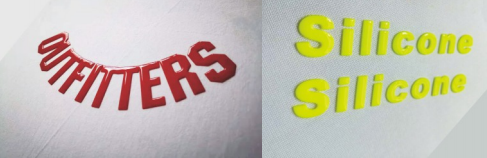
The “thick hand feel” of our crossing linkers is not a defect – it is a design feature. It creates a cushion layer that absorbs shear stress between rigid silicone prints and flexible fabric. This prevents cracking when the garment is stretched. Additionally, the crossing linker layer is compatible with both glossy and matte silicone topcoats without altering final appearance.

Why Choose Xinguang Yirun Crossing Linkers?
Here is a quick comparison with generic adhesion promoters:
| Criterion | Xinguang Yirun Crossing Linker | Typical Generic Adhesion Promoter |
|---|---|---|
| Adhesion on waterproof fabric | Excellent (passes 10+ washes) | Poor to moderate |
| Mix ratio stable | 100:5, easy to meter | Often vague (add until… ) |
| Direct printing performance | Good to best (XG-360Z-3X) | Poor screen release |
| Odor | Slight, worker-friendly | Sometimes strong solvent smell |
| Technical support | In-house lab testing available | None or limited |
| Batch consistency | ISO‑controlled | Variable |
Additionally, Xinguang Yirun provides:
- Sample kits for production line trials
- Technical datasheets with cure schedules and screen parameters
- Direct consultation for optimizing your print‑press temperature (typically 130‑160°C) and time
🔹 Ready to eliminate adhesion failures? [Request a free sample of XG‑360Z‑3X →]
How to Select the Right Middle Layer Adhesive for Your Printing Line
Before you buy, ask your supplier these five questions:
- Can it bond to both nylon and polyester with a waterproof coating? (Xinguang Yirun: yes)
- What is the recommended screen mesh for direct printing? (Our tech sheet recommends 110‑150 mesh for XG‑360Z‑3X)
- What is the pot life after mixing with catalyst? (Typically 4‑6 hours, longer for XG‑360Z‑3X)
- Does it require a primer or plasma pre‑treatment on fabric? (No – our crossing linker is the primer)
- Can you provide wash test data for my specific fabric? (We can run custom tests)
By using these criteria, you avoid rework, customer returns, and production slowdowns.
Frequently Asked Questions (FAQ)
1. What is the difference between XG‑360Z‑3 and XG‑360Z‑3X?
XG‑360Z‑3 is the standard crossing linker for reverse heat transfer printing and general use. XG‑360Z‑3X is an upgraded version with easier printability, lower cost, and stronger direct‑print adhesion. Both use a 100:5 ratio with their respective catalysts.
2. Can I use the same catalyst for both crossing linkers?
No. XG‑360Z‑3 requires catalyst XG‑360Z‑3B. XG‑360Z‑3X requires catalyst XG‑866B‑2. Using the wrong catalyst may result in poor curing or no cross‑linking.
3. Is a crossing linker necessary for all heat transfer printing on fabric?
Not for untreated cotton or standard polyester without water repellent finish. But for nylon, waterproof fabrics, and high‑density polyester, a crossing linker is essential to achieve industrial wash durability.
4. How should I store the two components before mixing?
Store both base and catalyst in a cool, dry place between 5‑35°C, away from direct sunlight. Keep containers tightly sealed. Shelf life is 12 months unopened. After mixing, use within 4‑6 hours for best results.
5. Can I request a sample to test on my own fabric and production line?
Absolutely. Xinguang Yirun offers free lab‑scale samples of XG‑360Z‑3 and XG‑360Z‑3X with their matching catalysts. Contact our team at [sales@xinguangyirun.com] or visit [your website URL] to arrange a sample shipment.